My legal name is John Hollingsworth, but everyone calls me Jack. I was born at 9:10 p.m. on January 3, 1954, at Cape Cod Hospital in Barnstable, Massachusetts. I like to imagine the delivery room had a view of the Atlantic Ocean, even if that’s more poetic than factual. That was the year Elvis cut his first record. The Cold War was just warming up. Ike was in the White House, and most TVs still had rabbit ears.
I had no idea what was in store for me.

Not long after I learned to walk, we moved inland to Reading, Massachusetts. We lived on Barrows Road. Our front door opened onto Lowell Street. Our back door opened onto Barrows. That sort of sums up who we were—a family that always felt halfway between two worlds. My father, John Jr., called “Bud” by many of his friends, taught math at the high school, coached football, and eventually became the school’s athletic director. He was respected—maybe even a little feared. My mother, Nancy, was a substitute teacher who somehow never lost her patience or her composure. People loved her. And she made one hell of an Apple pie.
Life back then was a black-and-white photograph with soft edges. We were middle-class, New England, Irish-Catholic in cultural heritage if not in practice. I had a good childhood. Played Little League. Rode bikes with no helmets. Fought with my siblings. Watched Rawhide and Combat. Loved seafood. Shoveled snow without complaining (much). I idolized Carl Yastrzemski and memorized the Red Sox lineup. I always had a sense that I was loved—but I also had one eye looking out the window, always wondering what else might be out there.
Summers were spent back on Cape Cod, in South Yarmouth, at our family’s modest beach cottage on Lambert Road. Screen doors, sandy floors, grilled hot dogs, and that unmistakable scent of low tide. To this day, that cottage is my spiritual center of gravity. It’s where I learned to skimboard, flirt awkwardly, and watch the sky burn pink at dusk.
In 1960, I started first grade at Lowell Street Elementary. The school was walking distance from our house, and there was a penny-candy store in between—one of those places that could make a dime feel like Christmas morning. I was in third grade when JFK was assassinated. I didn’t understand all of it, but I understood it mattered. The world felt a little less safe after that.
By the time I hit junior high at Coolidge, the world was changing fast. The Beatles, Vietnam, civil rights marches, moon landings. At Reading Memorial High School, I was an average athlete, a solid B-minus student, and a kid with charm but not much ambition. I didn’t know what I wanted to do—but I was sure it wasn’t what everyone else was doing.
I smoked a lot of weed.
In 1972, I left Massachusetts to study Forestry at Concord College in West Virginia. It was a culture shock. I lasted about a year. Then something surprising happened: I got swept up in the Jesus Movement. I left Concord and enrolled at Appalachian Bible Institute, graduating in 1978 with a degree in Christian Education. I was sincere. I didn’t become a preacher, but I believed deeply. Faith gave me structure, purpose—and a growing love for stories.
Somewhere in there, my uncle, a Rear Admiral, pulled a string and got me aboard the USTS Bay State III, a training ship for Massachusetts Maritime Academy. I was 21. Galley duty. Mop in hand. Camera in bag. It was a Minolta SRT 101, a gift from my father. I didn’t know the first thing about photography, but I knew how to look. And I looked—a lot.

In a park in Dublin, I took a picture of an elderly couple sitting on a bench, the sun pouring through the trees like melted gold. That was it. The click that changed me. For the first time, I felt like I had made—not just taken—a photograph. That’s when photography got under my skin. I knew there was a new world in waiting.
From 1979 to 1983, I studied at Dallas Theological Seminary and earned a Master’s in Biblical Studies. Midway through, I also completed a second Master’s at Indiana University in Instructional Systems Design. That turned out to be a pivotal detour—it gave me a new way of thinking about communication, technology, and teaching.
The 1980s were a blur of production work. I co-founded a production company, Grayson and Hollingsworth, back in the VHS and Beta days. We shot corporate training videos and meeting communications. It was storytelling in suits and ties, but it paid the bills. I shot on Nikon, then Canon, then Mamiya. I traveled the world. I lit hotel rooms, cruise ships, beach scenes, models, cocktails. Big jobs. Big clients. Big-camera era.
In 1995, I married Shannon Everett. She was, and still is, my everything. The love of my life. We had two daughters: Emma in 1997 and Audrey in 2000. Both are artists. Both are grounded and mature, with a sense of humor that could melt steel. Emma married Tom. Audrey’s with Sam. I adore them all. Shannon and I later divorced, but we’re best friends. Still co-pilots in parenting. Still family.
In 2004, we moved to Austin, Texas. Austin felt like another chance. We enrolled the girls in the Austin Waldorf School. We spent Saturdays at the farmer’s market. Life was full of long dinners, good light, and music playing somewhere in the background.
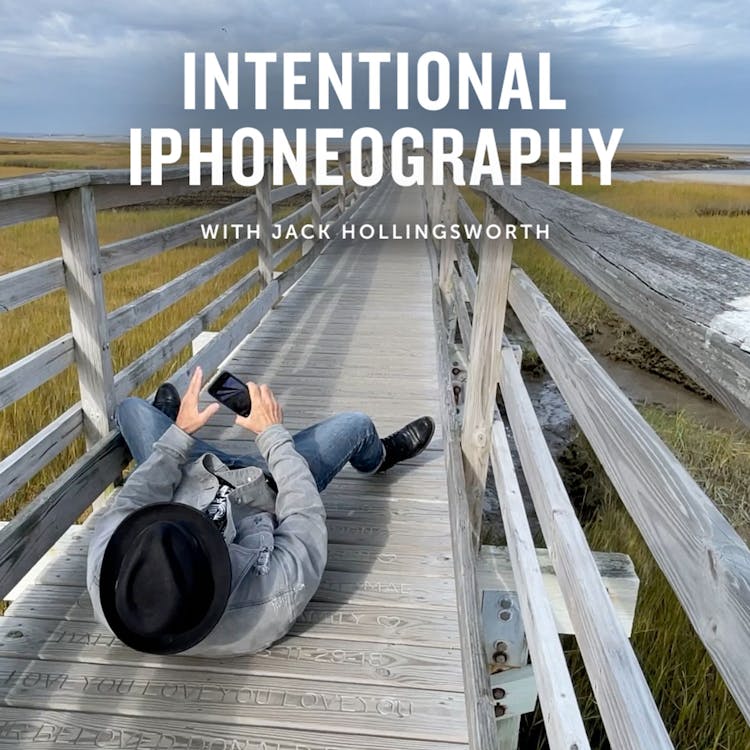
Then, in 2011, on a cruise assignment in Barbados, I lost my main camera bag. My fallback? The iPhone 4 in my pocket. I pointed it at the sunrise and clicked. That photo felt… freer. Lighter. More honest. That day—February 18, 2011—became my second photographic birthday.
Only a few years after that, I shot exclusively with iPhones. It wasn’t just about minimalism or convenience. It was about a new way of seeing. A new kind of intimacy with the world. I no longer needed a team or a tripod. Just my phone and my attention.
That same year, on October 5, Steve Jobs died. I was on assignment in the Mediterranean, and I felt the weight of it. The iPhone, I realized, wasn’t a gadget. It was a revolution. Photography had been democratized. You didn’t need $10,000 in gear to be a photographer anymore. You needed curiosity, presence, and a willingness to look closely.
I became known as iPhoneJack. I wrote two books. I appeared in Apple’s “Shot on iPhone” campaigns. My portrait was featured in their Maya Angelou “Human Family” ad. I gave talks. Taught workshops. Preached the gospel of mobile photography. But more than anything, I kept shooting. Every day. Rain or shine.
When my father passed in 2024 at the age of 97, it hit me harder than I expected. It made me re-evaluate what matters, what lasts. I shoot now not just for beauty or expression, but for memory—for proof that I was here, and that I paid attention.
Today, I live alone—but I’m not lonely. I bike around Lady Bird Lake every afternoon. I eat mostly fish. I sleep in a rooftop tent when the weather permits. I host and attend weekly family dinners. I love sports—especially the Dallas Cowboys, though they rarely love me back. I don’t watch the news much anymore. I read a lot. Write a lot. Still flirt a little.


Falcon 3 Evo Air Rooftop Tent – Ultra-Lightweight, Weatherproof & Built for Adventure (2-Person)
I’m 71 years old. I work like I’m 51. I feel like I’m 31. I travel constantly, chasing light with my iPhone and camping under the stars. I’ve shot over a million photos on this little glass rectangle in my pocket. And I’m just getting started.
So that’s me. No secrets. No shortcuts. Just a guy who took the long road—from Massachusetts to Texas, from Bible school to photo school, from DSLRs to iPhones. Along the way, I’ve made more mistakes than I can count, but I’ve also made a life I wouldn’t trade for anything.
Now you know Jack.
Click.
Jack.